Automated Private Ethernet Provisioning
As operators scale private connectivity across fragmented infrastructure, partner networks, and cloud environments, manual provisioning becomes the operational bottleneck.
The MaiaEdge Path Border Controller (PBC) and Path Computation Engine (PCE) automate private Ethernet path provisioning across any underlying transport to transform fragmented infrastructure into a unified network fabric. The solution combines a 1RU edge appliance with a cloud-native orchestrator that continuously computes optimal routes based on real-time latency, utilization, and policy metrics. New circuits, sites, and services activate in minutes across existing infrastructure, with hop-by-hop visibility across every path.
Product Description
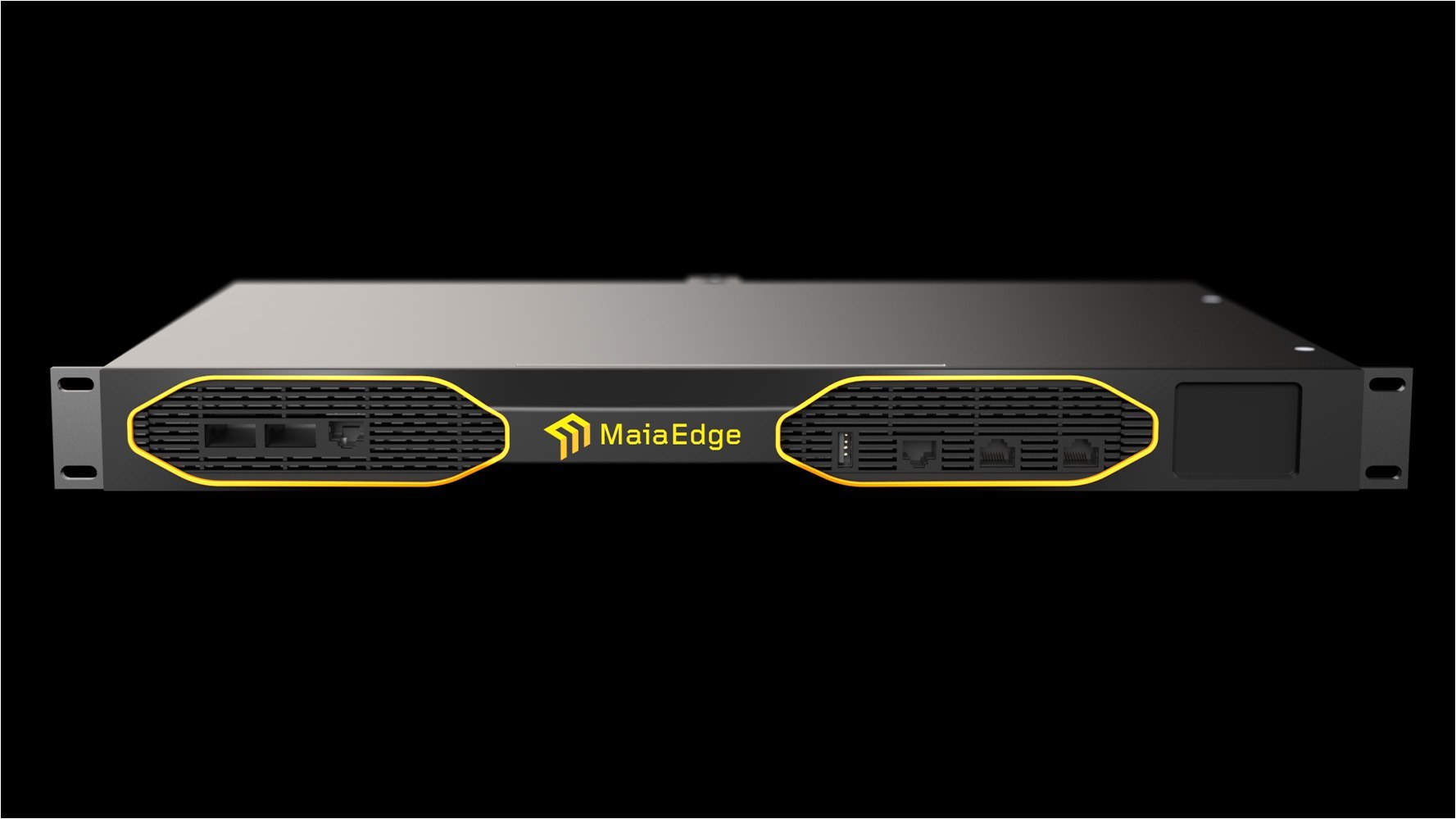
A dual 100G, 1RU appliance deployed at aggregation points, data centers, meet-me rooms, and strategic interconnection points. The PBC merges L2 switching and L3 routing to provision deterministic private Ethernet paths over any underlying transport, with line-rate AES-256-GCM IPsec encryption and less than 2µs latency overhead on every path.
For deployments requiring additional port density, the PBC pairs with the MaiaEdge Port Extender, an integrated switch that adds 48 tenant ports per appliance.
A cloud-native orchestrator that continuously computes real-time latency, utilization, and policy metrics to provision and maintain optimal paths automatically. The PCE also serves as a carrier-neutral interconnection engine, enabling providers to establish automated NNIs with partner networks in minutes, with hop-by-hop telemetry including jitter, packet loss, and latency extending across network boundaries.
Management and Orchestration
The solution is managed by an intuitive portal for point-and-click provisioning and performance monitoring, as well as a marketplace for finding partner providers and buying and selling connectivity services. The portal includes an optional white-label dashboard for end-users to view performance metrics on both the PBC and PCE.
Together, the PBC and PCE give operators a programmable private Ethernet fabric that provisions connectivity automatically across existing infrastructure, partner networks, and cloud environments. Operators can activate new circuits in minutes, extend their reach without new builds, and deliver new Layer 2 services by leveraging an ecosystem of partner providers.
Features & Capabilities
Activate encrypted private Ethernet paths in minutes across dedicated fiber or DIA, with automated NNI provisioning to partner networks. Eliminates manual configuration and associated configuration drift.
Merged L2 and L3 capabilities provide the flexibility to provision private Ethernet over dedicated fiber or DIA in a single unified fabric. Start with DIA for immediate connectivity and add fiber when available, retaining DIA as an automatic failover path.
Real-time route calculation based on latency, utilization, and policy metrics, with bandwidth allocation control and SLA proof. SRLG-aware path selection ensures true physical redundancy by automatically avoiding shared risk link groups.
Every path is secured automatically with line-rate AES-256-GCM IPsec encryption.
Hop-by-hop telemetry including jitter, packet loss, and latency across internal networks, partner networks, and cloud on-ramps. Operators can see exactly where performance degrades across every segment of the path, with data-backed SLA proof and enforcement.
An optional operator-branded portal gives customers self-service circuit provisioning and real-time visibility into their own paths. Q-in-Q tagging ensures complete tenant isolation on shared infrastructure. If a customer path crosses multiple providers, the partner network is abstracted from the customer’s view.
Native API integrations with Equinix and Megaport enable direct access to AWS Direct Connect, Azure ExpressRoute, and Google Cloud Platform (GCP). Provision cloud on-ramps in minutes with telemetry extending into the customer’s cloud environment.
API-first design enables direct integration with billing and operations systems for automated service activation and inventory management. Built for Mplify LSO Sonata interoperability.
Path Border Controller Technical Specifications
| Category | Specification |
|---|---|
| Performance | |
| Throughput | Dual 100GbE |
| Encryption Throughput | Line-rate AES-256-GCM IPsec |
| Latency | <2 µs overhead |
| Interfaces | |
| Port Configurations | Dual 100GbE Ethernet (QSFP28) |
| Management Ports | 2x 1GB RJ45 |
| External USB | 1x USB 2.0 |
| Console Port | RJ45 115.2 kbps |
| Physical | |
| Form Factor | 1RU Rackmount |
| Chassis (H × W × D) | 1.625 × 17.24 × 11.46 in |
| Total (With Ears and Tabs) | 1.625 × 19.02 × 12.13 in |
| Weight | 9.5 lbs (with power supplies installed) |
| Power & Environmental | |
| Power Supply | Internal: AC, DC |
| Redundant Power Supply | Yes |
| Operating Temperature | 0°C to 50°C (32°F to 104°F) |
| Storage Temperature | -40°C to 70°C (-40°F to 158°F) |
| Cooling | |
| Airflow | Internal fan-based forced-air cooling. Front-to-Back (F2B) — intake at front bezel / port side, exhaust at rear (fan/PSU side). |
| Data Center Airflow | Standard hot-aisle/cold-aisle layouts: cold aisle at front (bezel/port side) intake, hot aisle at rear exhaust. |
Subscription Licenses
The Path Border Controller hardware and cloud-based orchestration software are sold as a combined subscription. Available in 1, 3, or 5-year terms at 1G, 10G, or 100G throughput tiers.