You just spent $200 million on a data center.
State-of-the-art facility. Latest GPUs. Ten megawatts of power. Perfect ROI model.
Then the grid operator called: “Hey, about that power… you need to shut down between 2pm and 6pm when it’s hot.”
You: “Wait, what?”
Grid: “Conditional connection. You get priority access!”
You: agree to power down during extreme demand.
Your CFO, staring at the spreadsheet that assumed 24/7 operation: “So… we’re building a $200M facility with a bedtime?”
Grid: “Think of it as ‘flexible uptime.’”
Meanwhile, across town:
Enterprise CTO to service provider: “We need AI inference in Frankfurt, Singapore, and Chicago. Data can’t cross borders. Power costs matter. Can you coordinate this?”
Service provider: “Uh… let me check with three different vendors and get back to you in 60 days?”
CTO: “Our competitor launched last week.”
Welcome to 2026.
Where power became the bottleneck, nobody planned for. And it’s not the only thing that broke. While everyone was scrambling for AI infrastructure, signing capacity deals, racing to deploy GPUs, updating their “transformative” press releases, several foundational assumptions quietly crumbled.
The companies that noticed early aren’t panicking. They’re not explaining to their board why the data center sits dark during peak hours. They’re not scrambling to rewrite their infrastructure strategy mid-deployment. They figured out something simpler:
Data centers that can federate reach everywhere.
Service providers and fiber operators that can connect everything.
The ones who built that layer early? They are ready. Everyone else?
About to discover their “future-proof” plan needs some very expensive footnotes.
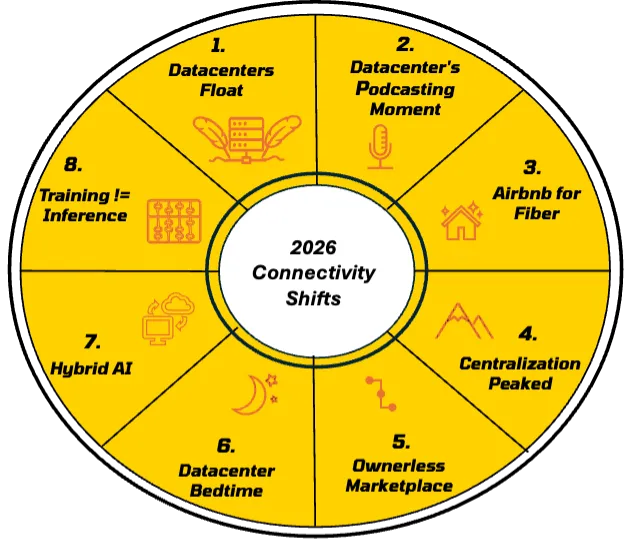
1. Data Centers: Extend Your Fangs or Become a Marriott
The clouds are coming to enterprises now. AWS just partnered with Lumen to deliver “last mile” connectivity. Enterprises don’t need to rack servers in Virginia anymore. The cloud shows up at their door.
Meaning data centers face a choice:
Extend your reach (federate with service providers to show up everywhere)
OR
Get phased out (watch traffic route around you)
If you can’t extend beyond your four walls? You’re converting your “carrier hotel” into an actual Marriott. Nice lobby. Continental breakfast. Open vacancy.
The clouds figured this out. They don’t make you come to them. They are starting to show up wherever you are. (Also, they charge you for leaving. But that’s a topic for another day.)
Data centers that can’t extend beyond their zip code? They’re becoming hotels with excellent HVAC.
Real estate still matters. It’s just not the product anymore.
2. Modular Data Centers: The Podcasting Moment
Remember radio? Huge infrastructure. Massive investment. Limited stations. You needed millions to play.
Then podcasting happened. Anyone with a mic could start one. Deploy anywhere. Move fast. Serve audiences anywhere.
Data centers are having their podcasting moment.
Instead of $200M facilities that take 18 months to build, shipping containers with full compute capacity drop in parking lots and go live in three weeks.
Why it works:
Flexibility beats monuments. Response beats prediction. Deployed beats “under construction.” Edge isn’t about shaving milliseconds. It’s about not explaining to your board why half the capacity sits empty.
The datacenter in a box shows up where the customer is. Any building with power and space. Any provider. Turns on fast. Not visionary. It’s just math that finally works.
3. Fiber Providers: The Airbnb Awakening
Remember when spare bedrooms were worthless? Then Airbnb showed up. Suddenly everyone’s running a hotel. Making money from assets that sat empty.
Fiber operators just had that moment.
Here’s what is changing:
Through federation, sharing infrastructure while remaining sovereign, you can sell services where you own ZERO fiber. You keep your network. You keep your customers. You just enable reach through partnerships.
Not silos. Ecosystem.
Customer in Boston wants to reach Paris? You coordinate with fiber operators who have networks in Paris. Service provisions. Everyone gets paid. Nobody surrenders anything. It’s like Airbnb but with conduits instead of couches. And way less awkward checkout conversations.
Fiber is the hardest infrastructure to build. Stop acting like it’s only worth wholesale rates.
4. Federation: Why Centralization Had a Great Run, But Reality Caught Up
Centralization was beautiful. One platform. One brain. Everything coordinated from the top.
Perfect… until reality showed up:
-
AI workloads everywhere (not just Northern Virginia)
-
Data sovereignty (enforced now)
-
Customers want options (not another lock-in)
What actually scales?
Federated infrastructure.
Independent network operators. Coordinating programmatically. Without surrendering:
-
Their network
-
Their customers
-
Their economics
No master controller. No platform rent. Just coordination. When the world gets complicated… Centralization gets expensive. Federation gets practical.
The answer isn’t simpler infrastructure. It’s smarter coordination.
And the operators who figured this out early? They’re not scrambling in 2027. They’re running.
5. The Ecosystem Emerged: The Marketplace That Nobody Owns
Most businesses assume marketplaces need:
-
One company in charge
-
Everyone else becoming “partners”
-
Margins collapsing “for scale”
What’s emerging is less dramatic. And way more interesting.
Think: Shopify meets Uber for networks.
Like Shopify: Merchants keep inventory, pricing, customers. Platform provides tools. Nobody surrenders control to sell.
Like Uber: Anyone can participate. Not just taxis. Any car. Platform coordinates, but doesn’t own assets.
A Marketplace for Network Services: Any operator can join. Keep your network. Keep your margins. Platform just coordinates.
For this to work, some unglamorous things have to line up: discovery, intelligence, pricing, quoting, billing, contracts, settlement and provisioning.
None of this is just cool. All of it is essential. It’s less “app store.” More “TCP/IP for transactions.”
2026 is when this connective tissue starts forming.
The companies building it won’t need to explain it in 2027. Everyone else will just wonder why deals now close faster.
The marketplace works for cloud connectivity and AI infrastructure. For edge deployments anywhere. Even in space. Even on Mars.
The coordinating layer stays. New participants join. Nobody owns it. Everybody uses it.
6. When the Grid Said “Not so Fast”
The numbers:
Texas (ERCOT): 205 GW of power requests. Last year: 56 GW. 70% from data centers.
Solution: “Conditional connections.”
Translation: “You get power when WE say you get power.”
What “conditional” means:
Priority access to the grid! You agree to shut down during extreme demand or bring your own generation or watch your AI workloads go dark
The ROI problem:
You modeled 100% uptime. Reality: 98.5% uptime (if you’re lucky). Your customers’ SLAs: 99.9% uptime.
The math: Doesn’t work anymore.
What winners do in 2026:
Seamless workload migration. Texas data center shutting down at 2pm? Customer’s AI inference moves to Oregon. Automatically. In seconds.
Loser: Explains downtime to customers. Winner: Customer never notices.
7. AI Went Hybrid (Nobody Asked the Cloud)
“Just put it in the cloud.” That was the answer for 10 years. 2026 is when it starts changing for AI.
What broke:
European bank wants AI. Data legally can’t leave EU. Cloud regions: Virginia, Oregon, Ireland (maybe).
Options:
A) Don’t do AI
B) Break laws
C) Run AI locally
Suddenly C is possible.
The hardware that enables this:
AMD just released chips specifically for on-premises AI inference. Not cloud chips. Not “send it to the data center” chips. “Run it in your building” chips.
Azure Local, AWS Outposts already exist. Originally for boring enterprise apps.
Now? Perfect for AI that can’t leave your country.
This isn’t “hybrid cloud.” This is “distributed chaos that needs orchestration.”
8. Training vs Inference - The Great Unbundling
December 2025. Nvidia bought Groq for $20 billion. For a chip company most people haven’t heard of.
Why? Because Groq’s chips do ONE thing: Run AI inference 10x faster than GPUs.
Why this matters:
For 5 years: “Buy GPUs for everything.”
Training? GPU. Inference? GPU. Existential questions? Probably GPU.
But training and inference are fundamentally different:
Groq built chips specifically for inference. 241 tokens/second. 10x more energy efficient. Air cooled (not liquid cooled)
Nvidia paid $20B to make sure you can’t buy them from anyone else.
What this creates:
Bifurcation.
Training Centers:
-
Massive facilities
-
Liquid-cooled
-
Concentrated
-
Where models get built
Inference Centers:
-
Distributed everywhere
-
Air-cooled
-
Close to customers
-
Where models actually run
Different infrastructure. Different economics. Different locations. This creates a coordination challenge nobody saw coming.
Training happens in a few massive facilities. Inference happens everywhere customers need it. Moving workloads between them based on power, latency, sovereignty, cost? All at once.
That’s not a single vendor problem. That’s an orchestration problem.
Connecting the Dots
Let’s connect what we just covered:
Data centers need to extend reach beyond their four walls. Fiber operators have underutilized capacity sitting dark. Service providers have POPs everywhere and relationships with everyone.
Put them together and something interesting happens. Who actually sits in the middle of all eight shifts?
Not hyperscalers (they’re busy being hyperscalers). Not enterprises (they can barely manage one data center).
The answer: Data centers, fiber operators, and service providers working together.
Here’s what they collectively have:
-
POPs everywhere inference needs to run
-
Fiber connecting everything
-
Facilities that work for distributed workloads
-
Relationships with enterprises AND clouds
-
Air-cooled infrastructure hyperscalers abandoned
-
No incentive to force one architecture
There’s just one problem:
The orchestration layer doesn’t exist yet.
The layer that knows:
-
Which data centers are going offline when
-
Where capacity exists right now
-
How to move workloads in under 60 seconds
-
How to coordinate traininginference distribution
-
How to enable all of this without everyone giving up control
Nobody built this. Because before 2026, we didn’t need it.
Now we do.
What this layer looks like:
Not a centralized platform. Not another vendor lock-in.
Distributed intelligence that:
-
Discovers what exists (real-time capacity, not stale databases)
-
Coordinates provisioning (seconds, not quarters)
-
Enables transactions (automated settlement, not manual invoices)
-
Respects sovereignty (operators keep control)
-
Scales participation (anyone can join)
It’s the connective tissue that makes federation actually work. Without it, everything stays theoretical.
With it, the industry shifts.
2026: The Foundation Year
This isn’t “everything changes overnight.” It’s “the layer everyone will stand on gets built.” By mid-2027, when the ecosystem shifts and the landscape changes…
The companies laying groundwork in 2026? They’re ready. They adapt. They run. Everyone else is still in the meeting where someone explains what happened.
The network didn’t just get faster. It got better at connecting itself.
At MaiaEdge, we’re building this coordination layer. Federated private networking that:
-
Lets data centers extend their reach
-
Enables service providers and fiber operators to orchestrate across domains
-
Connects all the dots
Without centralized control. Without surrendering sovereignty. Just distributed coordination that scales.
The foundation is being built in 2026.
The only question is: are you standing on it or explaining around it?